

Welcome to JALA!
Welcome to JALA International, the telework, telecommuting, and applied futures
research experts.
2023 marks the 50th anniversary of the words telework and telecommuting;
we coined them and we've been teleworking since the 1960s. For more on JALA's history see a
June 2012 article in Biztech
Popular Places
Here are some of the more popular places to visit on this site (also see the tabs above):
- Just what IS telework? Some definitions
- Can anyone telework? What kinds of jobs do teleworkers need to have?
- Is telework worth it? The cost-benefit analyses that help prove telework's positive impact on the bottom line—and the environment
- What can JALA tell me about teleworking/futures research? A look at JALA's publications
- How about links to related sites? A selection of sites closely related to telework and teleworkers
- Facts and opinions about telework, energy and global warming? Jack Nilles' blog
- How can tele-everything affect privacy and politics? A new look at Jack Nilles' 1982 book on the impact of PCs
What we do
JALA, an international group of consultants, helps business and government organizations in three main areas:
- Telework, telecommuting, and virtual organizations. We support telework program strategy development, program planning, teleworker and technology selection, training, program implementation and evaluation—including cost-benefit analysis. From inspiration through implementation. Advice to organizations and teleworkers.
- Applied futures research, including telework, climate change and energy use forecasting.
- Technology assessment. Investigating the potential impacts of new technologies.
We've provided a number of resources here to help you learn more about us, telework, and the future. Check out our services in Latin America. Or you might wish to read Jack Nilles' blog.
December 2023 marks the 50th anniversary of the publication of the seminal research report on telecommuting and telework. The report covers the first large-scale test of telecommuting in a real-world environment—an insurance company. This is where it all began. More than thirty years later eMarketer published a report demonstrating that, according to "a survey conducted among 254 global senior business executives by the Economist Intelligence Unit (EIU)," senior executives are still largely clueless about telework. The issues that worried them in 2004 were the same ones we showed were red herrings in 1974. Here is more information and a photo of the cover of the report. We hope to help rectify the red herring problem here.
If you can't wait to see how the next few decades will turn out, go directly to our forecast of telecommuting in the U.S.! To investigate what has been called "the Bible of telework and telecommuting," click on the book cover image below.

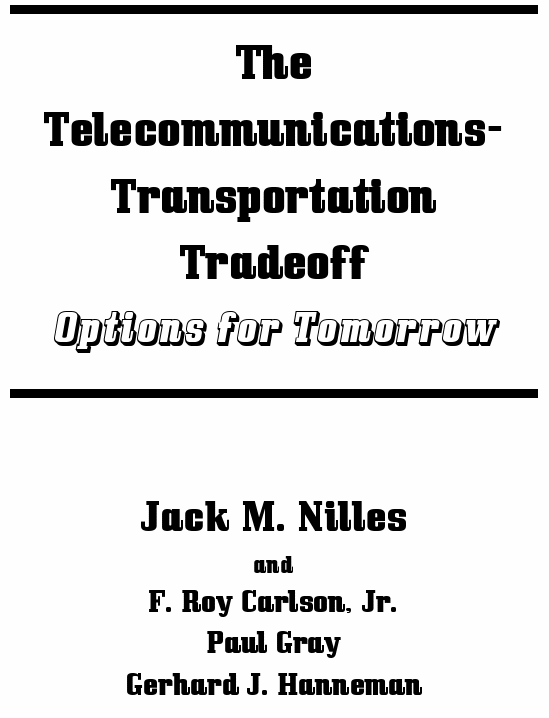
From the future to the past. The original version of our book The Telecommunications-Transportation Tradeoff was published in 1976. It covers our original demonstration of telecommuting that began in 1973. Long out of print, the book is now available again via Amazon and other on-line book purveyors. If you want the see how the world or telecommuting has changed since 1973 get this book.
One of our main themes is on determining the impact of telework on productivity. The issue is summed up nicely by Paul Graham in his keynote speech to OSCON (the open source convention) as reported by Phil Windley on ZDNet:
"The reason companies have fixed hours is that they can't measure productivity. The idea is that if you can't make people work, you can at least prevent them from having fun. If they're not having fun, they must be working! If you could measure what people really did, you wouldn't care when people worked."
Put simply, telework works! You can find much tested information about it on this site. You may also obtain more information by e-mail to jala.com.
Try Mozilla Firefox as your web browser.

Whether or not you telework you can help decrease the world's dependence on oil. Check the Detroit Project's web site for more details.

Finally, for topics other than the standard ones addressed in our main web pages, or for discussion of telework and other topics, please visit our weblog.
News and Articles
Evade the flu with telework!
There is quite a bit of public — again — concernabout the potentially catastrophic
effects of the avian flu virus H5N1. This possibility, like many others
in the disaster category, is one where telework can play a very important
part. More >>
JALA's blog.
For some more detail on topics represented on our web pages, or for
our—and others'—thoughts on related topics, please visit our
blog pages.
Time's Awastin' 2!
We've been doing some more research on the future of transportation,
particularly oil. To put it bluntly, we--humanity--will have used up
half of all the oil there is in the world sometime in 2007. If we could
continue to produce oil at the same rate as in 2003 we would totally
run out around 2050--no more oil at all. In the US about 70% of oil
is used by the transport sector. So enjoy your SUV while you can, or
get serious about teleworking. More >>
Telework and Tax Relief?
The 2005 US Federal budget includes a provision for tax relief to teleworkers and their employers.
More >>
Tsunamis and Telework
According to the Financial Times of 26 January, 2005, Oxfam's Fernando
Almansa has been directing the relief efforts from Spain. The reason?
More efficient uses of resources. "For instance,
Mr. Almansa, rather than flying immediately to the regions affected
by the tsunamis or shuttling between Oxfam offices, has performed
most of his coordination work since December 26 via the internet and telephone
from his home office in a small village 150
km from Madrid." This from an article about the relief organization's restructuring
for greater effectiveness.
Teletermination
On July 2, 2003, the New York state Court of Appeals ruled that a
telecommuter working from Florida for a New York firm was ineligible
for unemployment benefits when she quit after being told she must
move back to New York in order to continue her job. What's going
on here?
More >>
Test your teleworkability
If you are a prospective teleworker and are wondering how you can convince your employer to allow you to become
a more active teleworker or telecommuter you should be aware of a few realities. The first reality comprises the requirements of
your job to be in a specific location when you perform your job
tasks. So the first step is to evaluate your "teleworkability".
More >>
Telework and terrorism
One of the immediate side effects of 9/11 was
an increase in teleworking in the affected regions.
In many cases the sudden switch to teleworking was
a direct result of the disappearance of offices that
had been reduced to rubble. In other cases it was simply a precaution against
further terrorist attacks.
More >>
Telework and disasters
There are several other ways of instigating a sudden increase in interest
in telework. Pestilence, wars and natural disasters provide some fairly
recent examples.
More >>
Push to start?
Even though it is clear that a substantial
fraction of the US workforce considers telework to be one of the
most-desired perks—even in a challenged economy—we usually
tout telework to employers as an important management option for improving
competitiveness. But how does one get the boss to make the move?
Sometimes the government helps.
More >>
Time's awastin'!
The Middle East may now be slightly more stable. Or not. In any case it is way
past time for us to put more emphasis on the use of telework as an energy conservation
option. We have about hit the peak of world oil production; after this it's
all downhill.
More >>
Telepicker
is a trademark of JALA International. All other products mentioned are registered
trademarks or trademarks of their respective companies. Search is powered by iSearch from Z-Host.
Questions or problems regarding this web site should be directed to info at jala.com.
Last modified:
Tuesday February 28, 2023.